Comparison · October 30, 2026
Best Open-Source AI Tutors and Study Assistants You Can Self-Host
Four real projects, compared on the things that actually decide an install: licence, setup effort, and whether your models can stay local. Star counts are as of October 30, 2026 and move daily — popularity is not quality.
| Project | Licence | Stars (Oct 30, 2026) | Setup difficulty* | Local-model support |
|---|---|---|---|---|
| DeepTutor | Apache-2.0 | 50,838 | Moderate | Yes — Ollama, LM Studio, llama.cpp, vLLM, Lemonade |
| Open Notebook | MIT | 40,958 | Easy–moderate | Yes — Ollama and LM Studio, plus a local quick start |
| LearnHarness | AGPL-3.0 | 4,095 | Easy (desktop app) | Not documented — hosted providers via API keys; README warns local storage does not mean offline processing |
| Open TutorAI CE | BSD-3-Clause | 114 | Moderate | Yes — Ollama and OpenAI-compatible APIs |
*Setup difficulty is StackGuide's assessment from each project's documented install path, not a figure from the repo: LearnHarness is a desktop app, not a hosted server — that distinction matters if “self-host” means a server for you.
The projects, briefly
 DeepTutor — the best all-round tutor
A personal tutoring system that builds knowledge bases from your own documents and runs guided, mastery-based learning with reading, quizzes, practice, and chat grounded in those materials. Install by PyPI, Docker, or from source. Read our full DeepTutor guide →
 Open Notebook — the best study assistant
A self-hosted, NotebookLM-style assistant: organise PDFs, videos, audio, web pages, and notes into notebooks, chat with cited answers from your sources, and generate notes and multi-speaker podcasts. Docker Compose is the documented path. Label it a study assistant, not a Socratic tutor.
 LearnHarness — the most guided learner
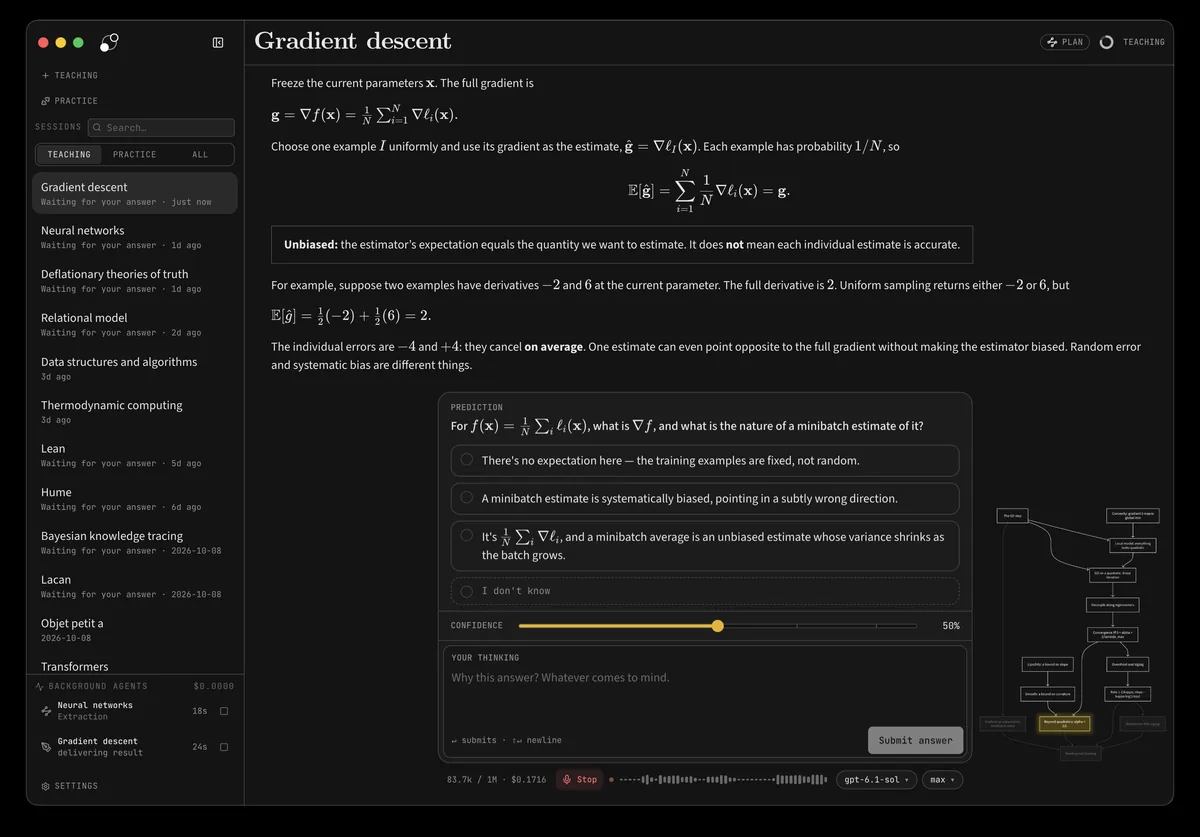
A desktop agent harness that probes where your understanding ends, plans a dependency map to your goal, then teaches one reasoning step at a time, storing learning as a persistent knowledge graph in local plain files. Easiest to install, but its documented providers are hosted APIs.
 Open TutorAI CE — the classroom option
A community-edition, AI-powered educational platform for personalised, avatar-based tutoring, with local RAG over textbooks, notes, and assignments, multi-model chat, and role-based access control. Note that it is the foundation for a proprietary Enterprise Edition. Docker Compose is recommended.
Our pick
Start with DeepTutor if you want a tutor, and Open Notebook if you want a study assistant over your own sources — both are mature, permissively licensed, and documented for local models. Pick LearnHarness if you want a desktop learning companion and are comfortable with hosted model APIs. Consider Open TutorAI CE for a classroom-style deployment.
Sources
- HKUDS/DeepTutor — LICENSE (Apache-2.0)
- lfnovo/open-notebook — LICENSE (MIT)
- amosblomqvist/learnharness — LICENSE (AGPL-3.0)
- Open-TutorAi/open-tutor-ai-CE — LICENSE (BSD-3-Clause)
This comparison was written with AI assistance and checked against the official repositories on October 30, 2026. General chat and RAG front ends were excluded because they are not purpose-built tutors or study assistants; hosted or closed products were excluded for the same reason.